


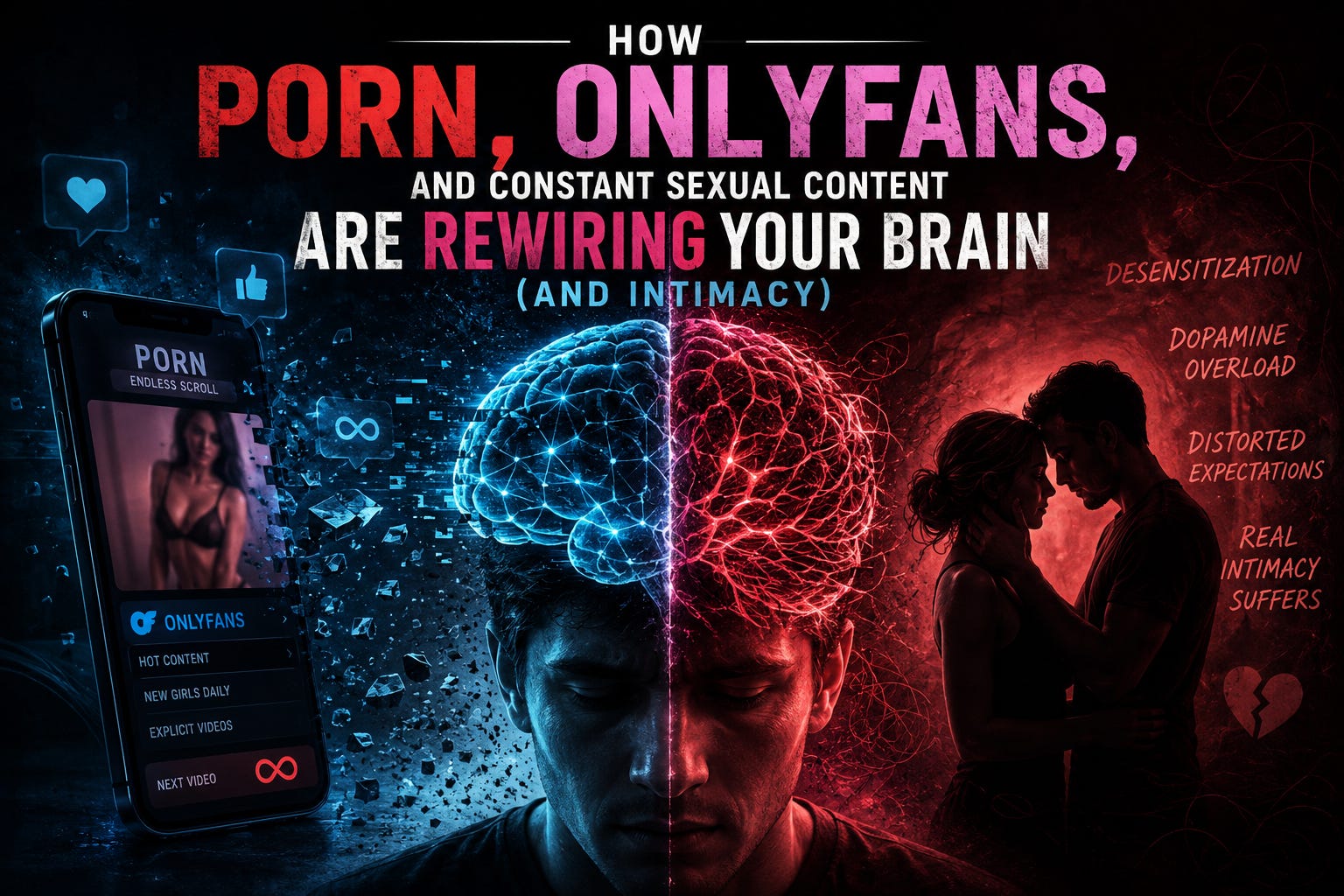
We’re not just seeing more porn.
We’re living inside a culture that sells sex everywhere, sometimes explicit, often implicit. Hot-tub streams. Edited Instagram bodies. Parasocial attention for sale. Algorithm-fed desire on loop.
And a quiet question keeps coming up:
Is all of this making real intimacy harder?
A psychiatrist’s short answer is uncomfortable but honest:
We don’t know everything yet.
But what we do know, isn’t great.
The Real Problem Isn’t “Sex on the Internet”
Sex is normal. Desire is human. Curiosity is human.
The problem is volume + design.
Modern platforms don’t just show sexual content.
They engineer it to pull on ancient wiring.
Your brain didn’t evolve for infinite novelty.
It evolved for survival.
And industries have learned how to use that.
The Twinkie Problem (But for Desire)
Think about food.
Your brain evolved to crave calorie-dense, sugary, fatty foods because that once helped humans survive scarcity. Then came Twinkies, pizza, and fast food industries built around that craving.
The result?
A preference that once protected us now harms us.
Sexual content works the same way.
Your brain is wired to notice beauty, novelty, status, attention, and reproductive cues.
Internet platforms, creators, and apps have adapted to that wiring.
Not always with evil intent.
Sometimes just because it performs.
Post A gets ignored.
Post B in something skimpier gets attention.
So Post B becomes the template.
Over time, the feed becomes a Darwinian machine — constantly discovering what your nervous system can’t ignore.
That’s why so much of today’s content isn’t always pornographic.
It’s sexually implicit, designed to activate the same circuits without saying it out loud.
If that analogy hit, this writing takes real time.
Want more honest psychology like this, free?
What We Know So Far About the Mental Cost
Science can’t keep up with how fast this content is evolving. OnlyFans-scale parasocial intimacy barely existed in mainstream culture a few years ago. Research moves slowly. Platforms move overnight.
Still, patterns are showing up.
1. Earlier and more intense porn exposure raises addiction risk
The earlier and more intense the exposure, the more vulnerable some people become to compulsive use. This isn’t moral panic. It’s psychiatric pattern recognition.
2. Expectations get distorted
Porn doesn’t just show sex. It teaches a script.
One clinical example: a patient believed they couldn’t orgasm “fully” during masturbation. In reality, they were orgasming — but pornography had trained them to expect an unrealistic visual standard. Their own body felt broken only because media had rewritten “normal.”
That’s how subtle this gets.
3. Your brain can wire to artificial intensity
Some people develop a need for stronger, faster, more specific stimulation. Real intimacy can start to feel flat by comparison, not because real intimacy is broken, but because the comparison is unfair.
This is why “death grip,” escalation, and desensitization come up so often in these conversations.
4. Intimacy gets confused with consumption
When sexual content becomes constant background noise, sex can start to feel less special, less exciting, less bonded, less human. Desire becomes easier to access and harder to deepen.
OnlyFans Changed the Game: From Images to Parasocial Bonding
Classic porn was mostly one-directional: look, feel, leave.
OnlyFans (and similar platforms) added something more powerful:
Interaction.
Attention.
Personalized desire.
The feeling of being chosen.
That parasocial layer can intensify attachment, jealousy, secrecy, and relationship conflict, especially for people already vulnerable to loneliness, anxiety, or insecure attachment.
Some partners may feel fine with it.
Relationship norms are changing. Open relationships and polyamory are more visible than before.
But for many couples, the wound isn’t just “they watched porn.”
It’s:
They sought intimacy, attention, and emotional charge from someone else, on demand.
That’s a different psychological category.
This Is Bigger Than Porn. It’s Cognitive Climate Change.
Here’s the bigger frame:
Humanity is going through a cognitive climate change.
Just like the industrial revolution gave us fossil-fuel progress and environmental consequences, the internet age gives us connection, entertainment, and knowledge — and mental side effects.
Depression is rising.
Anxiety is rising.
Loneliness is rising.
Attention is fragmenting.
Porn is part of that.
So is OnlyFans.
So is YouTube.
So is Twitch.
So is every app that monetizes your nervous system.
That doesn’t mean technology is evil.
It means new power requires new literacy.
The goal of a healthy culture isn’t to freeze progress.
It’s to stop getting blindsided by it.
The Future Risk: When Desire Becomes Fully Simulated
If current trends continue, VR, haptic feedback, AI companions, personalized fantasy partners, the gap between simulated intimacy and human intimacy may get even wider.
Not because people are weak.
Because the product will become more “optimized” than real relationships ever can be.
Real people get tired.
Real people disagree.
Real people have moods, needs, and limits.
A perfectly responsive digital partner doesn’t.
That’s why this conversation matters now, before the next wave arrives.
So What Do You Do With This?
You don’t need shame.
You need awareness and communication.
A healthier path looks like this:
Notice what your brain is being trained to expect.
Intensity? Novelty? Instant attention? Unrealistic performance?Talk about it with your partner before it becomes a secret.
Secrecy feeds shame. Shame feeds compulsion.Separate desire from intimacy.
Desire can be stimulated by content. Intimacy is built by presence, trust, and mutual care.Reduce high-intensity inputs if real life feels numb.
If your baseline is maxed out, ordinary connection will feel underwhelming.Treat this as nervous-system hygiene, not moral failure.
You’re not broken for being shaped by an environment designed to shape you.
Whoa this is really good work.
Hii