

There is a version of you that is sure you notice things.
You were in the room. You were looking. You would have seen it if it mattered.
That version of you is the most confident liar you live with.
The gorilla in the middle of the frame
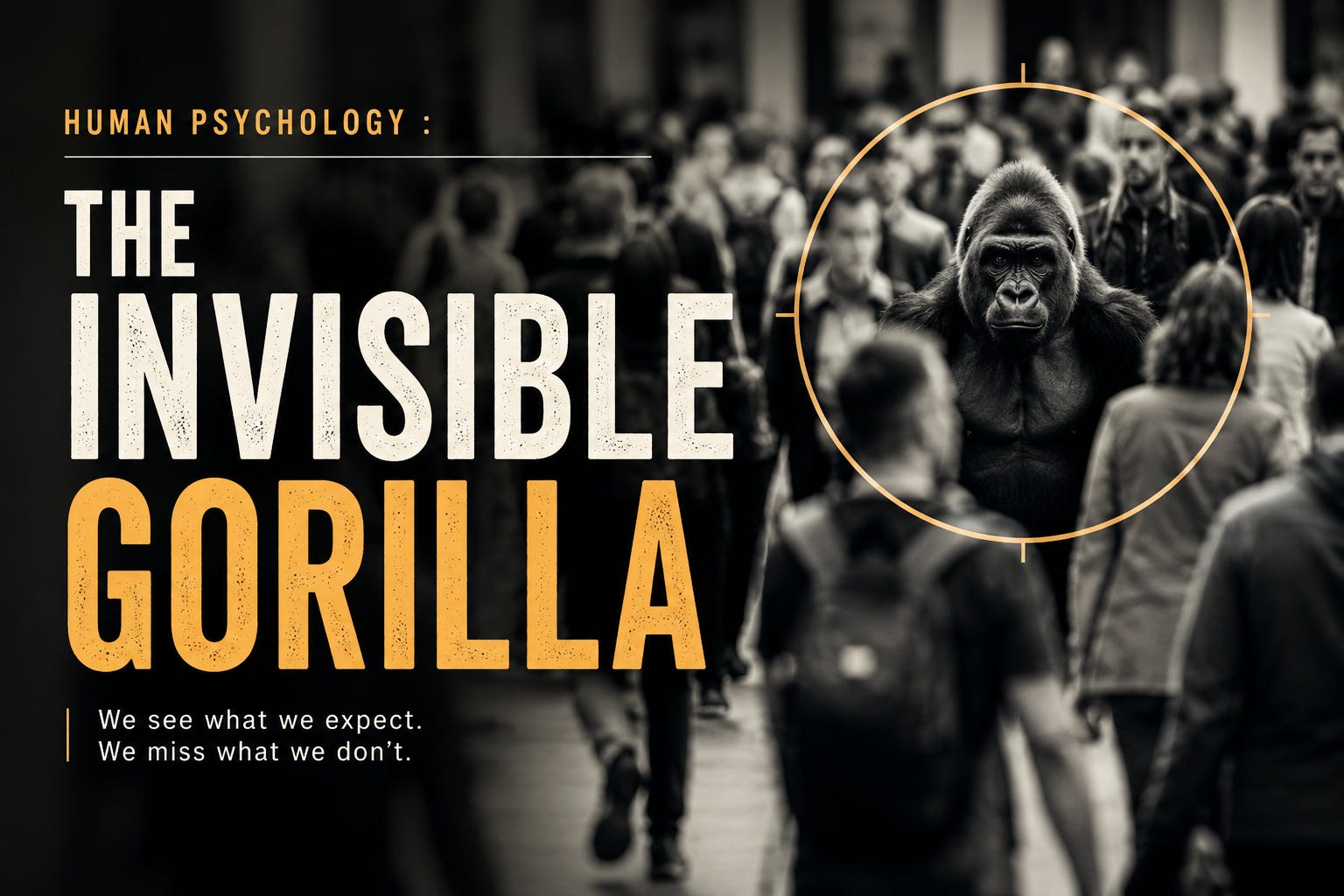
In 1999, two researchers, Daniel Simons and Christopher Chabris, asked people to watch a short video. Simple job. Count the passes between players in white shirts.
Midway through, a person in a gorilla suit walks into the middle of the frame. Stops. Beats its chest. Walks off. Nine seconds on screen. Not hidden. Not fast. Not in a corner.
About half the people never saw it.
When they watched again, some of them got angry. They thought the tape had been swapped. Because the gorilla was obvious. Because they had been looking. Because a mind that is looking cannot, surely, miss a gorilla in the middle of a basketball game.
They had been looking.
They had not been seeing.
The miss is not the scary part
That is the part that should sit in your chest for a minute.
Not that humans get distracted. Everyone knows that.
That you can stare at a scene, do the task you were given, feel present, and still be blind to the most ridiculous object in the room. Then walk away certain that nothing unusual happened.
The miss is not the scary part.
The certainty is.
Attention is not a camera
A camera records the whole frame whether you care or not. Your mind does not. Your mind is a narrow beam. Whatever it is counting, it lights. Everything else falls into a kind of darkness that does not feel like darkness. It feels like the world.
You do not experience the gorilla as missing.
You experience a complete video.
That is the trick. Absence does not announce itself. The brain does not leave a blank where the gorilla was. It hands you a finished story and lets you live inside it.
So you say, I would have noticed.
No. You would have noticed if you had been looking for that. You were looking for passes.
Even the people trained to look
Years later they put a tiny gorilla into a lung CT scan. Real radiologists. Experts. People trained to find the small thing that can kill you. They were hunting nodules. The gorilla was twenty times the size of the average nodule, sitting in the image like a joke.
Most of them never reported it.
Eighty-three percent.
If you think this only happens to civilians with a basketball video, that is the same confidence again. Expertise does not give you a wider beam. It gives you a better beam for the thing you were told to find. The rest of the picture can still vanish.
The gorilla is rarely a gorilla
Now take the experiment out of the lab.
You have driven a road you know and arrived with no memory of the last two miles. The car got there. Some part of you was counting the equivalent of passes: lane, brake lights, the next turn. The rest of the world went dark without feeling dark.
You have been in a conversation and realized, late, that the other person had already changed. The voice was thinner. The jokes had stopped. It was all on their face. You were looking at them. You were thinking about your reply.
You have lived in a house with someone and missed the night they started sleeping farther away on the bed. Not because you did not care. Because you were busy counting the other passes: work, money, the next thing that needed handling.
The gorilla is rarely a gorilla.
It is the mood in the kitchen.
The child who stopped coming in to talk.
The friend who only texts first.
The tremor in your own chest you keep calling tired.
It stands in the middle of the frame and beats its chest for nine seconds, or nine months, and then it leaves, and you swear the tape was normal.
Seeing is not what the eyes do
There is a name for this. Inattentional blindness. The words are colder than the fact.
The fact is: seeing is not what the eyes do. Seeing is what attention permits.
Light hits the retina either way. The gorilla is on the eyeball. It does not make it into the version of the world you get to keep. So later, when someone says how did you not see that, you feel accused of not caring. Sometimes that is fair. Often it is not. You can care and still be pointed at the wrong count.
That is not an excuse. It is the mechanism.
The mechanism does not make you innocent. It makes you dangerous in a quieter way. You will miss what you are not looking for, then defend the miss as proof it was not there.
“I was right here”
Watch how this works in a fight.
Someone says, you never notice.
You say, I was right here.
Both can be true.
You were right here, counting. They were the gorilla. They needed to be seen without auditioning for the task you had decided mattered. You walked off the tape with a complete memory of the evening. Their memory has a person in a suit, standing in the middle, unanswered.
This is why “I would have noticed if it was important” is such a cruel sentence. Importance is not a siren. Importance is often quiet, off-assignment, standing where you did not point the beam.
The person in the same room
Phones make this worse, but they did not invent it.
The basketball video is from before everyone lived inside a rectangle. The beam was already narrow. The rectangle just gives it a more addictive thing to count. Every ping is a pass. The gorilla can be a person in the same room, waiting for you to look up, while you feel very present to a screen that is not them.
You will remember being busy.
They will remember being alone in front of you.
You will never get the full list
Here is the goosebump, if you want it named.
You will never get a full list of the gorillas you have missed.
That is the structure of the thing. The ones you catch, you catch on the second watch, when someone tells you to look. The ones nobody mentions stay inside the first tape. Your life, as you tell it, is the first tape. It feels complete. It is not. It is the passes you were counting, stitched into a world.
There are conversations you were in and not in.
There are dangers you drove past.
There are loves that tried, once, in the middle of the frame, and then stopped trying.
You can be a good person and still have a mind like that.
The mind is not cruel. It is limited. It sells you the limit as if it were the whole field of view.
There is no wider camera
I do not have a clean fix. Anyone who does is selling a wider camera than a human head can hold.
What you can do is smaller, and harder.
Stop trusting the feeling of having seen. That feeling is cheap. It comes free with every focused task.
Ask, once in a while, what you were not counting.
Put the phone down long enough for a face to become the task.
On a drive, say out loud what you are actually looking at.
In a room with someone you love, look for the thing they are not putting into words.
You will still miss some of it. That is the deal of having one beam.
But you do not have to keep walking out of the tape so sure.
The honest position
The gorilla was there.
Half of us never saw it.
The other half should not get proud. We were told to look for passes too. We just got lucky about which frame our attention was in.
The honest position is not I notice everything.
The honest position is: I notice what I am pointed at. The rest of the world can walk through the middle of my life, beat its chest, and leave, and I will tell the story of a normal day.
That should make the hair on your arms move a little.
Not because a gorilla is coming.
Because some of them already came. And your mind, trying to be helpful, never put them in the cut.
One coffee is not a tip for a trick. It is a vote that this should exist next week too. No course. No funnel. No one selling you a wider camera.
Just enough to keep looking at what the first tape left out.
If you cannot give, send this to someone who has been in the room with you and still felt unseen. That is support too.
The gorilla was there. I am going to keep writing as if that matters.
Lovely piece, it reminds me of what Carl Jung said about our dreams. While we often think that dreams, especially to someone as captivated by them as Jung, would be sacred, he compared them to apples on the apple tree and that some will ripen, some will not, some we will eat, some will fall to the ground and rot and never be seen. Such is our attention and what we actually see and what will never be remembered.