


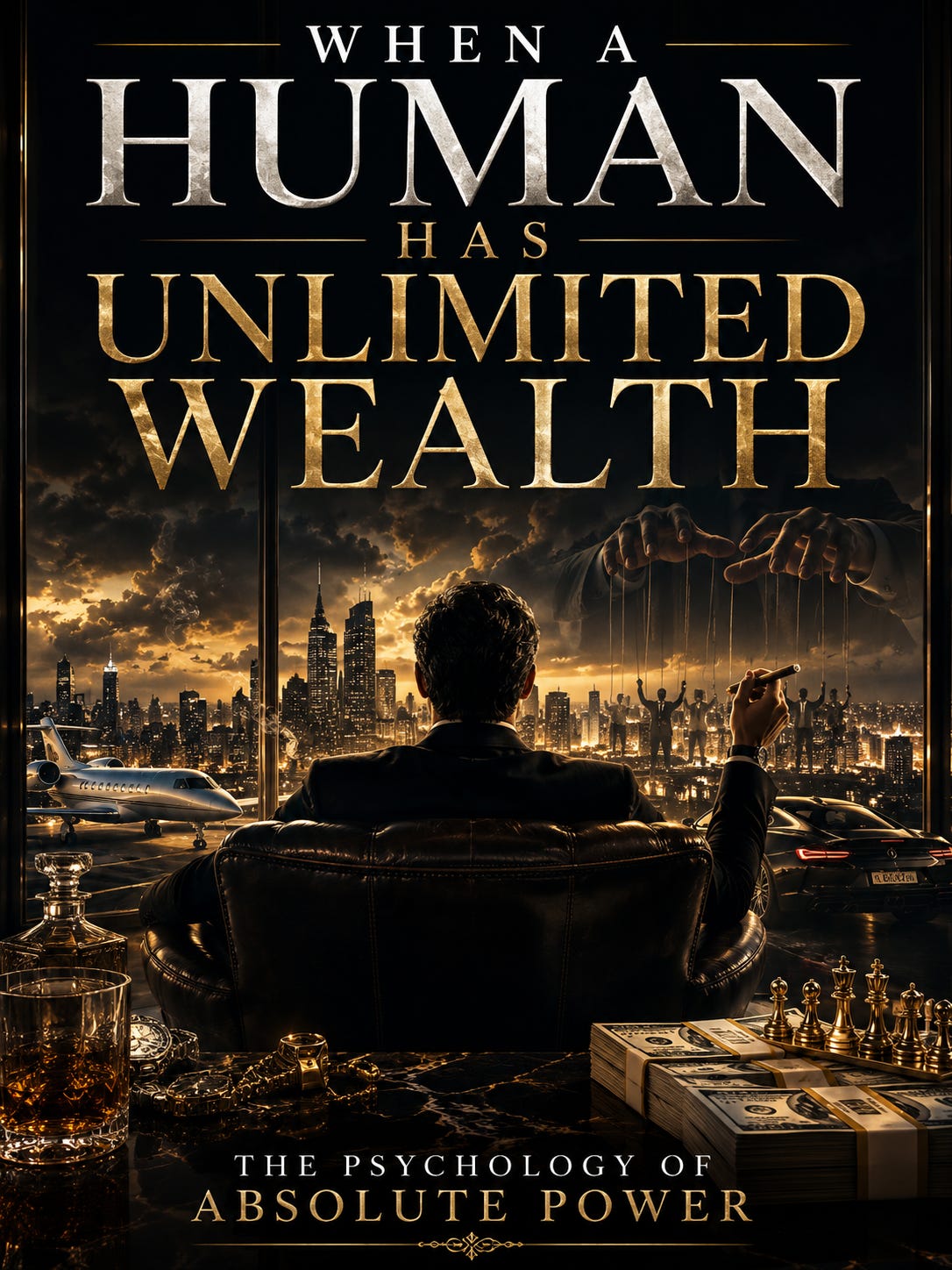
There is a point where money stops behaving like money.
At the trillion-dollar level, wealth is no longer about comfort.
It becomes about power over reality itself:
economies can be influenced
governments can be pressured
technology directions can be shaped
human behavior can be engineered at scale
And psychology has a very uncomfortable question here:
What happens to a human mind when consequences start to disappear?
1. The Erosion of Consequence
Human morality is not just internal.
It is built on consequences.
We learn:
“If I do this, I lose something”
“If I harm, I am punished”
“If I cross a line, there is resistance”
But extreme wealth can distort this system.
When nearly every consequence becomes:
negotiable
transferable
or avoidable
the brain slowly weakens its emotional connection to moral limits.
Not instantly.
Gradually.
Quietly.
2. Power and Psychological Disinhibition
Research in behavioral psychology shows a consistent pattern:
As perceived power increases, empathy regulation often decreases.
This does not mean powerful people become “evil.”
It means something more subtle and more dangerous:
emotional distance increases
other people feel less “felt”
outcomes matter more than impact on individuals
This is called psychological disinhibition under power.
And it scales with isolation.
3. The Reality Distortion Problem
At extreme wealth, reality itself becomes editable:
media narratives can be influenced
environments can be controlled
feedback can be filtered
disagreement can be insulated away
Over time, this creates a psychological risk:
The world stops correcting the person.
And when reality stops pushing back, belief systems can drift.
Not necessarily toward violence, but toward detachment from human constraints.
4. Moral Blind Spots at the Top
One of the most studied effects in power psychology is this:
Powerful individuals often do not feel they are immoral, they feel they are necessary.
This creates a dangerous internal logic:
“I understand systems better than others”
“I am responsible for outcomes, not feelings”
“Hard decisions are required”
From the inside, it feels rational.
From the outside, it can look very different.
5. The Isolation Loop
Extreme power also produces a feedback loop:
fewer equals → fewer honest challengers
fewer challengers → fewer reality checks
fewer reality checks → stronger internal certainty
Eventually, the person may live in a psychological environment where:
disagreement feels rare, and agreement feels engineered
This is where decision-making becomes most fragile.
Not because of intelligence.
But because of lack of friction.
6. The Core Psychological Risk
The real danger of unlimited wealth is not that it automatically creates “bad people.”
The risk is more subtle:
It can weaken the natural systems that keep human behavior grounded in shared reality.
Empathy requires proximity.
Humility requires resistance.
Ethics requires consequence.
When those are reduced, psychology shifts.
Not toward monsters.
But toward detached decision systems operating above ordinary human feedback loops.
If this article made you think, feel, or see something differently, consider supporting the work.
Your coffee helps keep Human Psychology independent, honest, and alive. ☕